
SWAMI RAMA HIMALAYAN UNIVERSITY
Swami Ram Nagar, Jolly GrantDehradun - 248016, Uttarakhand, India
How to Approach Choosing a Degree When You Don’t Know What Career You Want
Admin
October 26, 2026
Career Guide
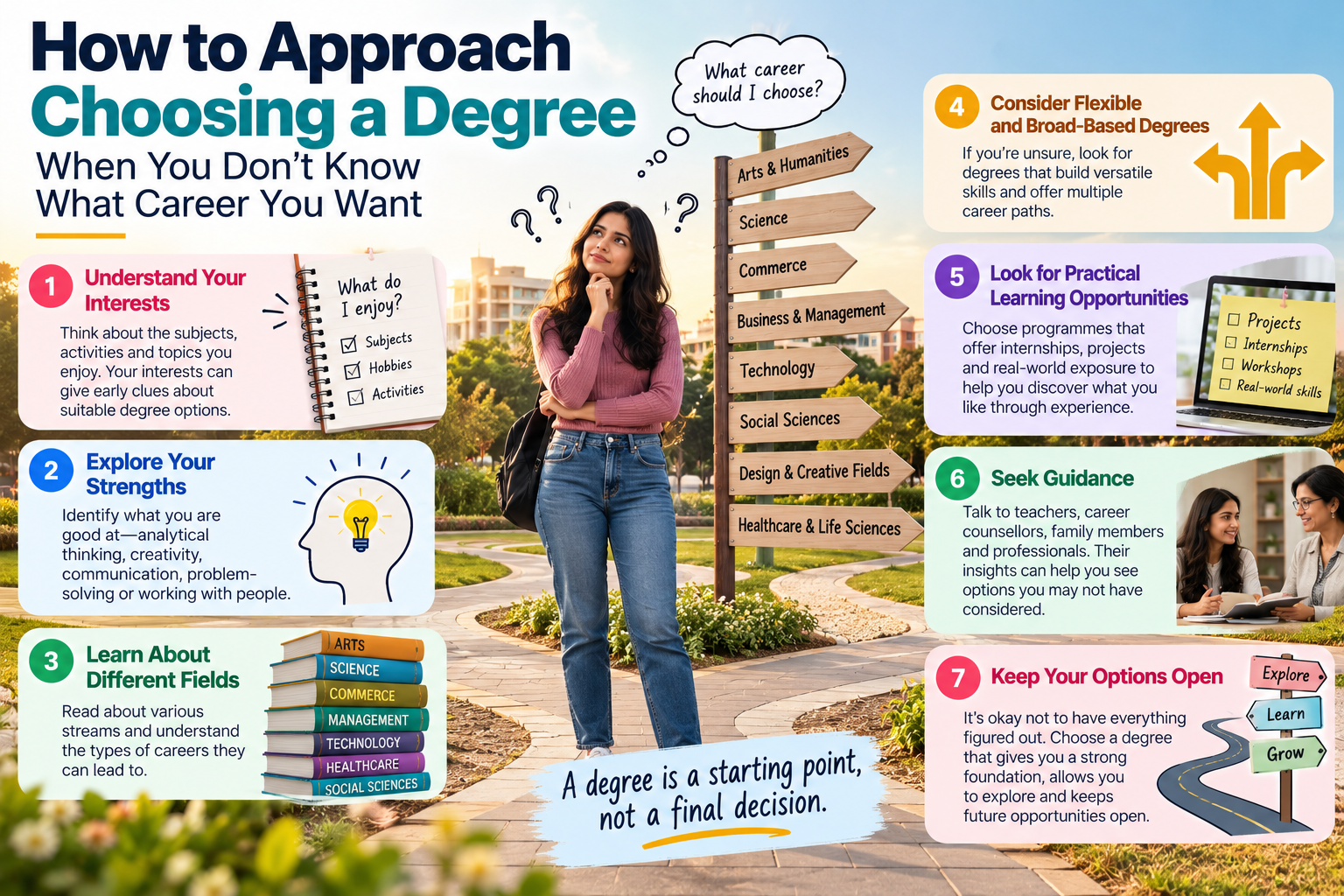
When the career destination is unclear, the most reliable approach is to choose a degree that builds transferable skills, keeps several career paths open and allows specialisation later. Understanding how to choose a degree in this situation means shifting the question from “What will I do for the rest of my life?” to “Which degree gives me the strongest foundation and the most room to adjust?”
Being undecided is not a weakness in the decision. Choosing a degree without a career goal is common among school leavers, and a structured approach turns that uncertainty into an advantage: time to explore, test interests and discover strengths before narrowing down.
This guide explains why uncertainty is a normal part of early career development, sets out a practical method for making the decision, identifies the factors that matter most, and shows which degree types and job roles suit learners who want to keep their options open.
Table of Contents
- Why Uncertainty at 17 Is Normal and Increasingly Sensible
- Recognising the Kind of Undecided
- The COMPASS Method: A Seven-Point Decision Framework
- What Actually Deserves Weight in the Decision
- Exploring Before Committing
- Making the Choice After Class 12
- Degrees That Keep Doors Open
- Where These Pathways Lead: Job Roles to Know
- A Plan That Can Change Without Collapsing
- Frequently Asked Questions
Why Uncertainty at 17 Is Normal and Increasingly Sensible
The world of work is changing faster than career guidance traditionally assumed. Many of the roles that will be available to today’s school leavers do not yet have settled job titles, which makes flexibility a rational strategy rather than indecision.
Trends reshaping early career decisions
- Skills are shifting quickly: employers surveyed for the World Economic Forum’s Future of Jobs Report expect 39% of workers’ core skills to change by 2030 (WEF).
- Careers are less linear: in Deloitte’s latest global Gen Z and Millennial Survey, 21% of Gen Z respondents said they would move laterally or step back to find the right role, and 44% prefer steady progress over rapid promotion (Deloitte).
- Learning outranks salary: the Unstop Talent Report, based on over 37,000 Indian students, found that 60–65% rank learning and skill development as the top factor in a first job, compared with 11–13% for salary (Business Today).
- AI is now a career adviser: 72% of Gen Z respondents in the Deloitte survey use AI tools for career advice, adding a new source of exploration alongside counsellors and family.
- Education has become more flexible: the National Education Policy (NEP) has introduced four-year undergraduate programmes with multiple entry and exit points and the Academic Bank of Credits, allowing learners to adjust their path without losing earned credits.
Together, these trends change the logic of career and degree choice. A degree is no longer a single irreversible commitment; it is the first platform in a career that will likely include several turns, upskilling phases and role changes.
Recognising the Kind of Undecided
Not every undecided student faces the same problem, and the right response depends on the type of uncertainty. Identifying which description fits best makes the next step clearer.
| Type of uncertainty | What it looks like | Most useful next step |
|---|---|---|
| The Explorer | Interested in many subjects, with no clear favourite | A broad-based degree with electives across disciplines |
| The Torn-Between-Two | Drawn to two specific fields, such as business and technology | A degree that combines both, or one with a strong minor option |
| The Pressure-Driven | Uncertain because of conflicting expectations from family or peers | An honest self-assessment and an informed family conversation |
| The Late Bloomer | Not yet sure of strengths, often after average academic results | A foundational degree with multiple exit points and skill-building |
| The Practical Planner | Prioritises employability and earning early over subject passion | A job-oriented degree with internships and flexible study options |
A well-chosen degree for undecided students responds to the type of uncertainty, not just to marks or stream. An Explorer needs breadth, while a Practical Planner needs early employability; the same degree will not serve both equally well.
The COMPASS Method: A Seven-Point Decision Framework
The COMPASS Method is an original degree selection guide designed for learners without a fixed career goal. Instead of starting with a job title, it guides the decision through seven direction-setting checks that point towards a sound choice.
| Letter | Check | Question to answer |
|---|---|---|
| C | Curiosity | Which subjects or problems hold attention even without exams? |
| O | Options | How many career paths does this degree keep open? |
| M | Market | Is there steady demand for the skills this degree builds? |
| P | Personal strengths | Does the degree play to existing abilities, such as numbers, communication or logic? |
| A | Affordability | Is the total cost, including living and opportunity costs, manageable? |
| S | Stepping-stones | Does it allow exits, credit transfer or later specialisation? |
| S | Support | Are there mentors, career services and peers to guide the journey? |
A degree that scores well on at least five of the seven checks is usually a safe and productive starting point. The method’s value lies in replacing a single high-pressure question with several smaller, answerable ones, which makes the decision feel manageable for both students and families.
Benefits of a structured method
- It reduces decisions driven by peer pressure or popular trends alone.
- It gives families a shared vocabulary for discussing options calmly.
- It balances interest, practicality and affordability in one view.
- It highlights flexibility, which protects the decision if interests change later.
What Actually Deserves Weight in the Decision
The most important factors to consider when choosing a degree go beyond marks and rankings. Each factor below addresses a different risk, and together they produce a balanced choice.
- Interest and aptitude: sustained interest predicts effort, and effort predicts outcomes more reliably than initial ability.
- Transferable skills: communication, analytical thinking, problem-solving and digital literacy carry value in almost every field.
- Flexibility: electives, minors, multiple exit options and credit transfer protect against a change of direction.
- Recognition and quality: UGC recognition, NAAC accreditation and the strength of the faculty determine the credibility of the qualification.
- Practical exposure: internships, projects and industry interaction help students discover what they enjoy in real settings.
- Cost and return: total fees, living expenses and expected starting opportunities should be weighed together.
- Mode of study: campus, online and blended formats suit different financial and personal circumstances.
- Progression routes: the availability of postgraduate options, such as an MBA or MCA, that allow specialisation later.
Exploring Before Committing
Learning how to decide what to major in is mostly about gathering evidence rather than waiting for certainty to arrive. Small, low-cost experiments reveal interests faster than reflection alone.
Practical ways to test interests
- Aptitude and interest assessments: structured career assessments identify patterns in abilities and preferences.
- Short online courses: free introductory modules in business, coding, design or finance provide a quick taste of each field.
- Conversations with professionals: brief informational interviews reveal what a job involves day to day.
- Job shadowing and volunteering: observing real work clarifies whether a field suits temperament as well as interest.
- Subject reflection: reviewing which Class 11 and 12 topics felt engaging, not just which scored well.
- AI-assisted exploration: using AI tools to map careers linked to an interest, then verifying the findings with a counsellor.
A simple self-check helps clarify how to choose the right degree after this exploration: if a subject still feels engaging after a short course, a conversation with a professional and some independent reading, it deserves serious consideration.
Making the Choice After Class 12
The stream studied in school shapes the starting options but does not lock in a career. Choosing a degree after 12th is mainly about understanding which doors each stream opens and which degrees accept students from any background.
| Aspect | Broad-based degrees (BBA, B.Com, BCA) | Narrow professional degrees |
|---|---|---|
| Career range | Wide: business, finance, technology, operations, entrepreneurship | Focused on a single regulated profession |
| Entry requirements | Class 12 in most streams, often without entrance examinations | Specific subjects and competitive entrance examinations |
| Ease of switching | High: skills transfer across sectors and to postgraduate study | Lower: switching often means starting again |
| Best suited to | Undecided learners and those wanting flexibility | Students with a clear, long-held career goal |
| Specialisation timing | Later, through electives, MBA, MCA or certifications | From the first year |
For many learners, a broad-based undergraduate degree followed by a specialised postgraduate degree offers the best balance. It allows three or four years of exploration before committing to a specific field.
Degrees That Keep Doors Open
The best degree for undecided students is one that builds core skills valued across industries while leaving room to specialise. Business, commerce and computer applications degrees meet this test well, because their skills apply in almost every sector of the economy.
Undecided today can mean unstoppable tomorrow with the right foundation. Explore the flexible undergraduate and postgraduate pathways at SRHU Dehradun to find a degree that grows with changing goals.
Programmes well suited to undecided learners
- Bachelor of Business Administration (Honours): introduces management, marketing, finance and human resources, helping students discover which business function suits them.
- Bachelor of Commerce (Honours): builds strong foundations in accounting, finance and economics, valued in banking, taxation and corporate roles.
- Bachelor of Computer Applications (Honours): develops programming and digital skills from the basics, opening technology careers without requiring an engineering background.
- Master of Business Administration: a natural second step for graduates of any discipline who later identify management or a business specialisation as their direction.
- Master of Computer Applications: allows graduates, including those from non-computing backgrounds with Mathematics, to move into software and IT careers.
Advantages of starting broad
- Time to discover: students explore several subjects before choosing a specialisation.
- Multiple exits: four-year honours programmes often award a degree after three years and an honours degree after four.
- Employability: transferable skills support entry into a wide range of roles.
- Progression: a broad degree leads naturally into specialised postgraduate study.
- Lower risk: a change of interest does not waste the years already invested.
Where These Pathways Lead: Job Roles to Know
Broad-based degrees connect to a large and varied set of careers. The table below lists common roles, which gives undecided learners a concrete sense of where each pathway can lead.
| Pathway | Example job roles |
|---|---|
| Business and management | Business development executive, marketing executive, HR executive, operations coordinator, management trainee, product manager |
| Commerce and finance | Accounts executive, financial analyst, tax consultant, banking associate, credit analyst, investment operations associate |
| Technology and computing | Software developer, web developer, data analyst, IT support specialist, quality assurance tester, cloud support associate |
| Data and analytics | Business analyst, market research analyst, MIS executive, data visualisation specialist |
| Digital and creative business | Digital marketing specialist, content strategist, e-commerce executive, social media manager |
| Entrepreneurship | Start-up founder, family business manager, independent consultant |
Many of these roles are open to graduates of more than one degree. A B.Com graduate can become a business analyst, and a BBA graduate can move into digital marketing, which is exactly the kind of mobility that protects an undecided learner.
A Plan That Can Change Without Collapsing
Effective degree and career planning treats the first year as an exploration phase and builds in checkpoints. A plan that expects adjustment is more resilient than one that assumes certainty from the start.
A year-by-year approach
- Year 1: explore core subjects, join clubs and complete one short course outside the main discipline.
- Year 2: choose electives based on what proved engaging and undertake a first internship or project.
- Year 3: narrow the focus, build a portfolio and decide between employment and postgraduate study.
- Year 4 (honours): deepen specialisation through research or advanced projects, or use the exit option to begin work.
Conversations with an experienced admissions counsellor often shorten the decision considerably, because they connect a learner’s interests to programme structures, eligibility and career outcomes in one discussion.
One honest conversation can turn confusion into a clear direction. Reach the admissions team through the Swami Rama Himalayan University Contact Number and discuss options with an expert before deciding.
Questions worth asking during a counselling session
- Which programme best matches current interests while keeping other paths open?
- What electives, minors or specialisations are available, and when must they be chosen?
- Do undergraduate programmes offer multiple entry and exit options?
- What recognition and accreditation does the degree carry?
- What career support, internships and projects are included?
- What is the total cost, and are flexible payment options available?
Frequently Asked Questions
What should I major in if I’m not sure?
A broad-based field such as business administration, commerce or computer applications is a sound choice, because these degrees build transferable skills and keep many careers open. Specialisation can follow later through electives, certifications or a postgraduate degree.
What to do if you’re not sure about your career?
The most effective approach is to explore actively: take short courses, speak to professionals, try internships or volunteering and complete a career assessment. Choosing a flexible degree in the meantime ensures progress continues while clarity develops.
What career is Gen Z most interested in?
Indian Gen Z students show strong interest in technology, banking and financial services, consulting and consumer goods, with leading technology firms topping preferred-employer lists in the Unstop Talent Report. Entrepreneurship is also widely favoured. Across sectors, Gen Z rates learning and growth opportunities above salary when choosing a first job.
How do I know which degree is right for me?
A degree is likely right when it matches genuine interests, uses existing strengths, leads to careers with steady demand, fits the family budget and allows flexibility. Testing interests through short courses and conversations with professionals before applying makes the choice more reliable.
What factors should I consider before choosing a degree?
The key factors are interest and aptitude, transferable skills, flexibility through electives and exit options, recognition and accreditation, practical exposure, total cost and expected return, mode of study and progression routes to postgraduate education.