SWAMI RAMA HIMALAYAN UNIVERSITY
Swami Ram Nagar, Jolly GrantDehradun - 248016, Uttarakhand, India
Online Degree vs Regular Degree: Which One Is Better for Students?
Admin
June 25, 2026
Career Guide
A decade ago, this was not a real question. The default path was clear: attend a college, complete a degree, enter the workforce. The possibility of earning a recognised, career-relevant qualification entirely online without sacrificing rigour, credential value, or employment outcome simply did not exist in any meaningful form. That has changed, and changed faster than most people in education expected. Today, the question is not whether online learning is legitimate. The question is whether it is the right fit for the person asking, and that is a far more interesting and useful question to answer.
Understanding the difference between online and regular degree programmes requires moving past surface comparisons, campus vs. screen, fixed schedule vs. flexible timing and into what actually determines whether a graduate is prepared, competitive, and employable. The structural differences are real, but they are not uniformly advantageous in either direction. What matters is which structure serves the learner's actual situation, goals, and constraints.
Table of Contents
- What the Shift to Online Learning Actually Signals
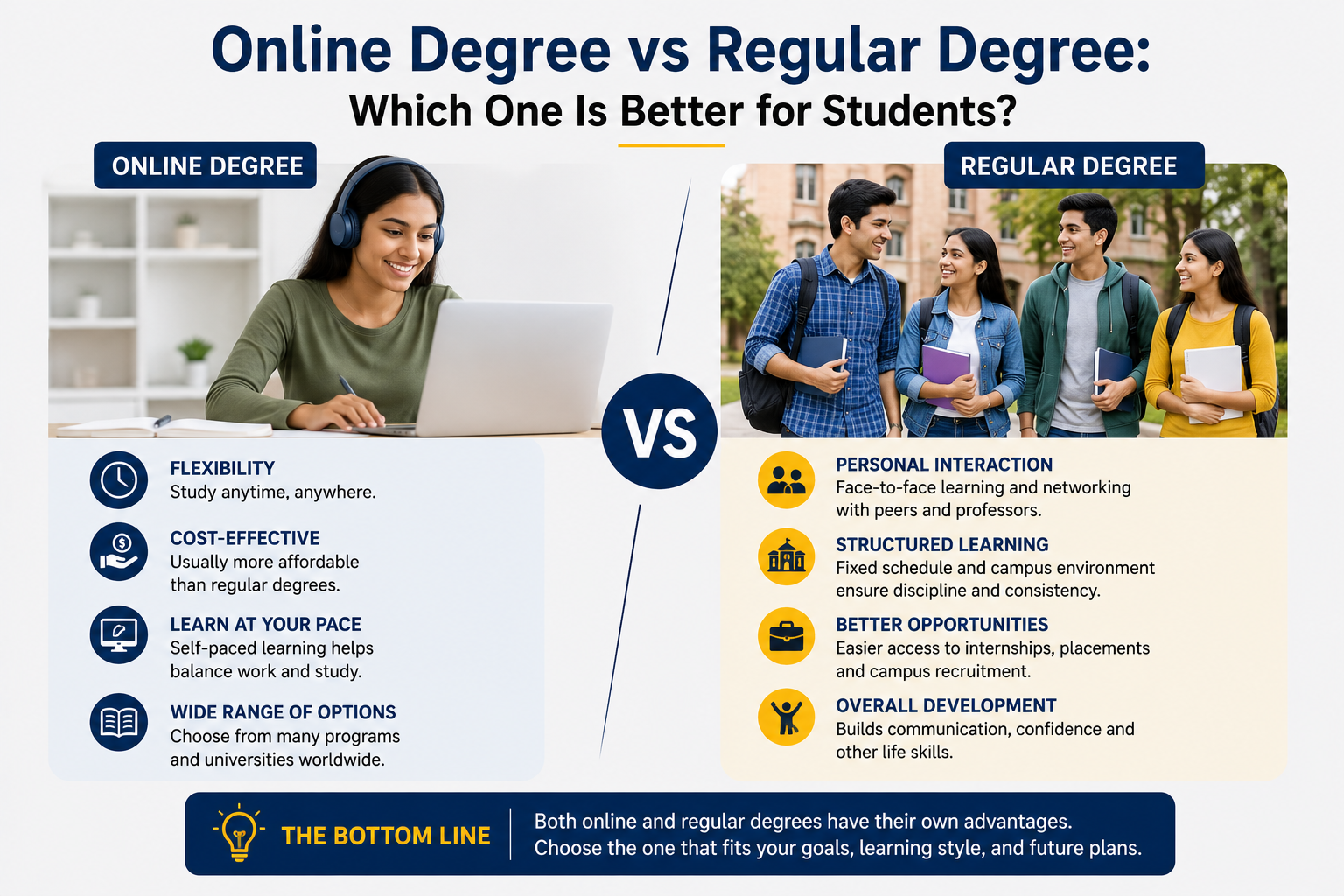
- Online Degree vs Traditional Degree: A Structured Comparison
- The Decision That Keeps Students Up at Night
- Who Should Choose Online and Who Should Think Differently
- What Well-Designed Online Education Actually Delivers
- The Skills Online Education Builds and the Roles They Lead To
- Where This Is All Heading and What It Means for Students Deciding Now
- Frequently Asked Questions
What the Shift to Online Learning Actually Signals
The growth of structured online education is not primarily a story about technology. It is a story about access. A common pattern in education systems globally and particularly in India is that the most capable learners are not always the most geographically or financially proximate to quality institutions. Online degree programmes disrupt that pattern structurally. They decouple quality education from physical location, which means a student in a Tier 2 or Tier 3 city can now access the same curriculum, faculty expertise, and credentials as a student in a metro. That is not a minor convenience. It is a structural correction.
The hidden implication here is about risk reduction on the employer's side. Hiring a fresh graduate carries inherent uncertainty. An internship-integrated degree reduces that uncertainty because it demonstrates the student has already navigated a real workplace: met deadlines outside academic settings, worked within teams they did not choose, and applied theoretical frameworks to actual business problems. The Internship Integrated BBA Program is, in effect, a risk-reduction signal for recruiters and graduates who understand this framing present themselves far more compellingly in interviews.
The hidden implication here is about who benefits most. The conventional narrative frames online education as a fallback chosen when campus admission is not possible. A more accurate framing is that online degree benefits are structural advantages for specific learner profiles: those managing professional commitments, those seeking geographic flexibility, those who are self-directed learners, and those who need a credential without a four-year interruption to their working life. For these learners, online is not the second option. It is the better option.
🔍 Pattern Insight
There is also a pattern insight worth naming: employers, particularly in technology, consulting, finance, and digital marketing, have rapidly shifted their evaluation criteria. They are increasingly assessing what a candidate can do, not where they studied. This shift has materially improved the employment outcomes of online graduates who have paired their degree with demonstrable applied skills. The credential still matters. But it is no longer the only thing that matters.
Online Degree vs Traditional Degree: A Structured Comparison
The debate is often framed as binary when it is actually contextual. The table below is not about which is universally better; it is about which serves different learner profiles more effectively.
| Online Degree | Traditional Degree |
|---|---|
| Study from any location, no relocation required | Requires physical presence on campus |
| Flexible scheduling: morning, evening, or weekend | Fixed timetable with mandatory attendance |
| Lower overall cost; no accommodation or commute expenses | Higher total cost, including campus fees and living expenses |
| Designed for working professionals and self-directed learners | Suited to full-time students with few external commitments |
| Immediate application of learning to the current work context | Learning applied post-graduation or through internships |
| Strong in analytical, digital, and management disciplines | Strong for disciplines requiring lab work or clinical placements |
| Network built through digital platforms and alumni groups | Network built through campus proximity and in-person interaction |
| A degree holds UGC recognition when issued by accredited institutions | A degree holds traditional recognition across sectors |
| Requires self-discipline and time management | A structured environment supports learners who need an external routine |
| Access to recorded lectures, AI tools, and digital resources | Access to physical libraries, labs, and campus infrastructure |
The Decision That Keeps Students Up at Night
Most students who arrive at this question are not confused about what online learning is. They are uncertain about what it signals to employers, to their families, and to themselves. There is a social dimension to this decision that rarely appears in comparison articles. Choosing a traditional college is visible. It is a shared experience, embedded in cultural expectation. Choosing an online path requires a different kind of conviction, one that says: I understand what I am building and why this structure serves my goals.
For those already in the workforce, the dilemma is more practical. Returning to full-time education means pausing income, professional momentum, and in some cases, seniority. An online degree for working students solves this specific tension it makes continued education structurally possible without requiring a pause in career progression. This is not a compromise. For the right candidate, it is the only format that makes sense.
Families, particularly in India, often carry a strong bias toward campus-based education, associating it with discipline, social development, and institutional prestige. That bias is understandable and historically grounded. But the outcome evidence is shifting. Students who complete rigorous online programmes and pair them with consistent self-directed skill development are entering the workforce with profiles that are genuinely competitive, often more so than campus graduates who coasted through a traditional format.
Who Should Choose Online and Who Should Think Differently
Online education is well-matched for:
- Working professionals seeking advancement without a career break
- Students in locations without access to quality campus programmes
- Learners who are self-directed and disciplined about structured study
- Those managing family, financial, or caregiving responsibilities
- Students seeking cost-efficient pathways to recognised credentials
- Individuals looking to pivot into a new domain without starting over professionally
Traditional campus education is better suited for:
- Students who benefit from structured external accountability
- Disciplines requiring laboratory, clinical, or physical studio access
- Learners in a phase of life where full-time immersive education is feasible
- Those for whom the campus social and network experience is a primary goal
What happens if the wrong format is chosen? Students who choose campus education primarily out of social expectation but lack the financial support or the full-time availability it requires often disengage mid-programme. Conversely, students who choose online learning without the self-discipline or time infrastructure to sustain it tend to stall. The format is not the risk. Misalignment between format and learner reality is the risk.
🎓 Explore: Online Degree Program
What Well-Designed Online Education Actually Delivers
The online learning benefits of a well-structured programme extend well beyond scheduling convenience. They include: access to faculty and content that is continuously updated in response to industry demand; exposure to peers from diverse professional and geographic backgrounds; the development of digital collaboration skills that are themselves valued in modern workplaces; and the ability to apply learning immediately to a current professional context. This last point is underappreciated. A working student who studies supply chain management on Monday and applies a framework to their current logistics role on Tuesday is learning at a fundamentally different depth than a campus student who will apply the same concept three years later, in a different context, with faded recall.
The integration of AI powered online learning into structured degree programmes has added another dimension. Adaptive learning systems can now identify where an individual student is losing comprehension and adjust content delivery accordingly, something a traditional lecture format cannot do at scale. AI-assisted feedback on assignments, intelligent content recommendations, and conversational learning tools have raised the quality ceiling for online education significantly. The best online programmes today are not digital versions of campus lectures. They are architecturally different and in several measurable ways, more responsive to how adults actually learn.
The Skills Online Education Builds and the Roles They Lead To
Online education, when completed with genuine engagement, develops a specific and valuable competency profile. The skills for future careers that emerge from rigorous online programmes include:
- Digital literacy and platform fluency: Online learners navigate multiple digital tools, platforms, and communication systems as a matter of course. These are not peripheral skills in a modern workplace. They are foundational.
- Self-directed project management: Completing a degree while managing other responsibilities requires and builds the kind of autonomous discipline that employers increasingly value in remote and hybrid work environments.
- Analytical and data interpretation skills: Many online business and management programmes have integrated data tools directly into curriculum delivery, giving students hands-on exposure to analytics platforms as part of their learning.
- Written and asynchronous communication: Online learners consistently develop stronger written communication habits, as most collaboration and assessment happen through text-based and recorded formats.
- Cross-functional awareness: Cohorts in online programmes often include professionals from multiple industries and functions, which gives learners exposure to diverse business contexts and ways of problem-solving.
The intersection of AI and digital education is producing graduates who are not merely digitally aware but digitally operational, able to work within AI-assisted environments, interpret automated outputs critically, and contribute to technology-adjacent business functions from day one.
Job Roles Online Degree Graduates Qualify For
- Business Analyst
- Digital Marketing Specialist
- Operations Manager
- HR Business Partner
- Financial Analyst
- Project Manager
- Data Analyst (Business)
- E-commerce Manager
- Learning & Development Coordinator
- Management Consultant (Junior)
- Supply Chain Executive
- Content Strategy Manager
Where This Is All Heading and What It Means for Students Deciding Now
The future of online education in India is being shaped by three converging forces: regulatory support (UGC has formally recognised online degrees from accredited institutions as equivalent to campus degrees), technological advancement (AI and adaptive learning tools are raising quality and engagement), and employer behaviour (hiring managers are increasingly evaluating portfolios and demonstrated competencies over institution names). The cumulative effect of these three forces is a legitimacy trajectory that points sharply upward.
The idea of future ready education is not about which format is most prestigious today. It is about which format best equips a learner for the career environment they will inhabit over the next two decades. That environment will be digital-native, geographically distributed, project-based, and increasingly AI-augmented. Online education by its very structure prepares students for this environment in ways that traditional campus formats are only beginning to adapt to.
The graduates who will be most competitive are those with employability skills in 2026 and beyond: the ability to learn continuously, apply knowledge in real contexts, communicate across digital channels, and work productively without constant supervision. These are not skills that happen to be developed by online education. They are the skills that online education is structurally designed to build.
Key Trends Shaping Online Education Over the Next Three to Five Years:
- AI-personalised learning paths will become standard in quality online programmes, adjusting content depth and pace to individual learner performance data.
- Micro-credentialling and modular degrees will allow learners to build qualifications incrementally, reducing financial commitment barriers.
- Industry-integrated curriculum design will increase, with employers co-authoring content to ensure graduates arrive with role-relevant skills.
- Employer recognition of online credentials will continue to expand as outcome data from online graduates accumulates and becomes visible.
- Collaborative online learning tools will narrow the peer network gap that has historically been cited as a limitation of online formats.
The Clearest Things to Take Away From This
- Online and traditional degrees are not ranked against each other; they serve different learner profiles, and the right choice depends entirely on individual circumstances.
- The credential gap between online and campus degrees has closed significantly, particularly for business, management, and digital disciplines.
- Online education builds specific competencies, digital fluency, self-direction, and asynchronous communication that are directly relevant to modern workplaces.
- The UGC recognition of online degrees from accredited institutions means the qualification is legally and professionally equivalent to its campus counterpart.
- Working students are the strongest fit for online education; the format is designed around their constraints, not designed despite them.
- Choosing a format because it is expected rather than because it fits is one of the most common and costly mistakes in education planning.
Frequently Asked Questions
Which is better: an online degree or a regular degree?
Neither is universally better. A traditional degree is better for learners who need structured external accountability, are attending full-time, or are pursuing disciplines that require physical facilities. An online degree is better for working professionals, geographically constrained learners, and self-directed individuals who can sustain study alongside other commitments. The better question is: which format is better for your specific situation?
How can students decide which learning format is right for them?
Start with an honest assessment of three things: your current life structure (do you have the time and space for full-time campus attendance?), your learning style (do you need external routine or can you self-direct?), and your career goal (does your target role value credential origin or demonstrated competency?). In most cases, those three factors together point clearly toward one format or the other.
How do online and regular degrees support skill development?
Traditional degrees build skills through structured classroom instruction, peer interaction, and campus-based exposure. Online degrees build overlapping skills while additionally developing digital fluency, asynchronous collaboration, and autonomous project management, which are themselves high-value competencies in contemporary workplaces. Neither format has a monopoly on skill development; the difference lies in which skills are developed as a by-product of the format itself.
Are online degrees suitable for beginners?
Yes, provided the learner has the self-awareness and discipline to manage study independently. Many online programmes are specifically designed for learners without prior academic background in the subject, with structured onboarding, faculty support, and peer learning communities to ease the transition. The challenge for beginners is not the content complexity; it is the self-management required to stay consistent over the programme duration.
Is an online degree equal to a regular degree?
For degrees offered by institutions accredited under UGC-DEB guidelines, yes, the online degree is legally equivalent to a campus degree. Both carry the same institutional authority and meet the same educational standards. The equivalence is formal, not just informal. Employers governed by regulatory hiring requirements, such as government and public sector roles, for instance, are required to treat UGC-recognised online degrees on par with traditional ones.
Is an online degree valid for a job?
Yes. Online degrees from UGC-DEB-accredited institutions are valid for employment across the private sector, public sector, and government positions (subject to specific eligibility criteria for each role). The degree certificate carries the same institutional seal and recognition as a campus-issued degree. Employers who question online degree validity are often applying outdated criteria, and that population is shrinking as outcome data from online graduates becomes more visible in the market.