SWAMI RAMA HIMALAYAN UNIVERSITY
Swami Ram Nagar, Jolly GrantDehradun - 248016, Uttarakhand, India
How Swami Rama Himalayan University Online Is Adapting to the Future of Digital Education
Admin
April 23, 2026
Career Guide
What it looks like when a university doesn't just move courses online but rethinks the entire education experience for a digital world.
There's a tension building in Indian higher education that most institutions are still pretending doesn't exist. On one side: a rapidly expanding population of learners who need quality education but are geographically constrained, economically stretched, or professionally committed in ways that make traditional campus attendance difficult or impossible. On the other: a job market that is increasingly demanding demonstrated, current, applicable skills rather than credentials built around syllabi designed a decade ago.
The institutions that are responding honestly to this pressure, not by simply digitising lectures, but by redesigning the learning experience, are the ones setting the template for what Indian higher education looks like in 2026 and beyond. The question worth asking is: what does genuine adaptation actually look like? And how does Swami Rama Himalayan University's online education fit into that picture?
The answer requires looking past the surface, past programme catalogues and technology platforms to the design philosophy underneath. Because the universities that are adapting well aren't just adopting tools. They're making a different set of assumptions about who their learners are and what those learners need.
Table of Contents
- What 'Adapting to Digital Education' Actually Means
- Who Is Actually Choosing Online And What They're Navigating
- Who Should Choose SRHU Online and Who Should Think Carefully
- How SRHU Is Structuring Online Education as a Genuine Alternative
- What SRHU Offers Online: Programmes, Skills, and Career Paths
- The Internship Dimension: Where Learning Becomes Professional Capital
- How the Online Learning Model Actually Works?
- The Institutional Commitment: What Makes SRHU's Approach Distinct
- Is Studying Online at SRHU a Good Decision? An Honest Assessment
- What Students Actually Gain: Beyond the Credential
- Making the Most of What SRHU Offers
- Choosing the Right Programme: A Decision Framework
- Key Takeaways
- Frequently Asked Questions
What 'Adapting to Digital Education' Actually Means
When a university says it is adapting to digital education, the phrase can mean almost anything. For some institutions, it means recorded lectures on a portal. For others, it means a full redesign of how learning is sequenced, assessed, supported, and connected to employment outcomes. The gap between these two interpretations is enormous and consequential for students making enrolment decisions.
Pattern Insight
In most cases, the universities that are genuinely adapting to digital education share one characteristic: they stopped asking 'how do we put our existing programme online?' and started asking 'what does a learner who can't come to campus actually need to succeed?' That reframing changes everything from faculty roles to assessment design to the weight placed on industry connection.
In most cases, the universities that are genuinely adapting to digital education share one characteristic: they stopped asking 'how do we put our existing programme online?' and started asking 'what does a learner who can't come to campus actually need to succeed?' That reframing changes everything from faculty roles to assessment design to the weight placed on industry connection.
The hidden implication in most 'digital education' announcements is that format and content have been conflated. A programme delivered via an app is not inherently better than one delivered in a classroom. What matters is whether the pedagogical model of how learning is structured, how progress is assessed, and how students are supported has been genuinely redesigned for a distributed, asynchronous or semi-synchronous learner. This is the harder work. And it's where most institutions stop short.
Understanding how universities are adapting to digital education in India requires distinguishing between three levels of adaptation: surface-level (content online, assessment unchanged), structural (live interaction + cohort design + digital tools embedded), and systemic (curriculum co-designed with industry, outcomes tracked, continuous improvement built in). The universities doing systemic adaptation are a smaller subset, and they're producing measurably different outcomes.
Who Is Actually Choosing Online And What They're Navigating
The learner considering an online programme from a university like SRHU is rarely the profile most people assume. It's not primarily someone who wants an easier route. It's a student in Dehradun, Haridwar, or a smaller Himalayan town who has real ambition but no access to a top-tier campus programme in their city. It's a working professional who wants to upskill or formalise a credential without resigning. It's a student whose family situation doesn't allow relocation but whose intellectual capability is fully equal to any campus peer.
What these learners share is a practical constraint that conventional education doesn't accommodate and a need for the institution to meet them where they are. The confusion most of them carry isn't about whether online education is legitimate. It's about whether a specific programme, from a specific institution, will actually build the skills and credentials that move their life forward.
Contrarian Insight
One of the biggest gaps in how online programmes are evaluated is the assumption that 'online' means lower rigour. In practice, a well-structured online programme often demands more self-discipline, more active engagement, and more demonstrable output than a campus programme where attendance substitutes for learning. The students who thrive in SRHU's online environment are not those who chose it for convenience; they're the ones who engaged with it as a professional commitment.
One of the biggest gaps in how online programmes are evaluated is the assumption that 'online' means lower rigour. In practice, a well-structured online programme often demands more self-discipline, more active engagement, and more demonstrable output than a campus programme where attendance substitutes for learning. The students who thrive in SRHU's online environment are not those who chose it for convenience; they're the ones who engaged with it as a professional commitment.
The transition challenge is real: moving from a school system built around physical attendance to a learning model that requires self-direction and digital fluency is not trivial. The institutions that acknowledge this and build support structures around it, orientation programmes, academic mentors, peer cohorts, produce dramatically better outcomes than those that assume the learner will figure it out.
Who Should Choose SRHU Online and Who Should Think Carefully
Who is well-suited:
- Students in Uttarakhand and surrounding regions who want the credibility of an established university without the cost and disruption of relocating to a metro
- Working professionals looking to formalise a qualification or build domain knowledge while remaining employed
- Learners who are self-directed, digitally comfortable, and clear about the career outcome they're working toward
- Students who want access to SRHU's academic infrastructure, faculty, library, and research resources without being physically present on campus
Who should consider carefully:
- Students who are entirely undecided about their career direction and need the campus environment's organic exposure and peer influence to figure it out
- Those who thrive exclusively in structured, physical classroom environments and struggle significantly with self-paced learning
- Learners who haven't verified the specific programme they're considering is UGC-DEB approved a non-negotiable check before any online enrolment
What happens if the fit question is ignored?
The pattern is consistent: students who choose an online programme without evaluating fit either disengage within the first semester or complete the programme but feel unprepared for the transition to work. Neither outcome serves the student. The decision deserves the same rigour as any significant career investment.
How SRHU Is Structuring Online Education as a Genuine Alternative
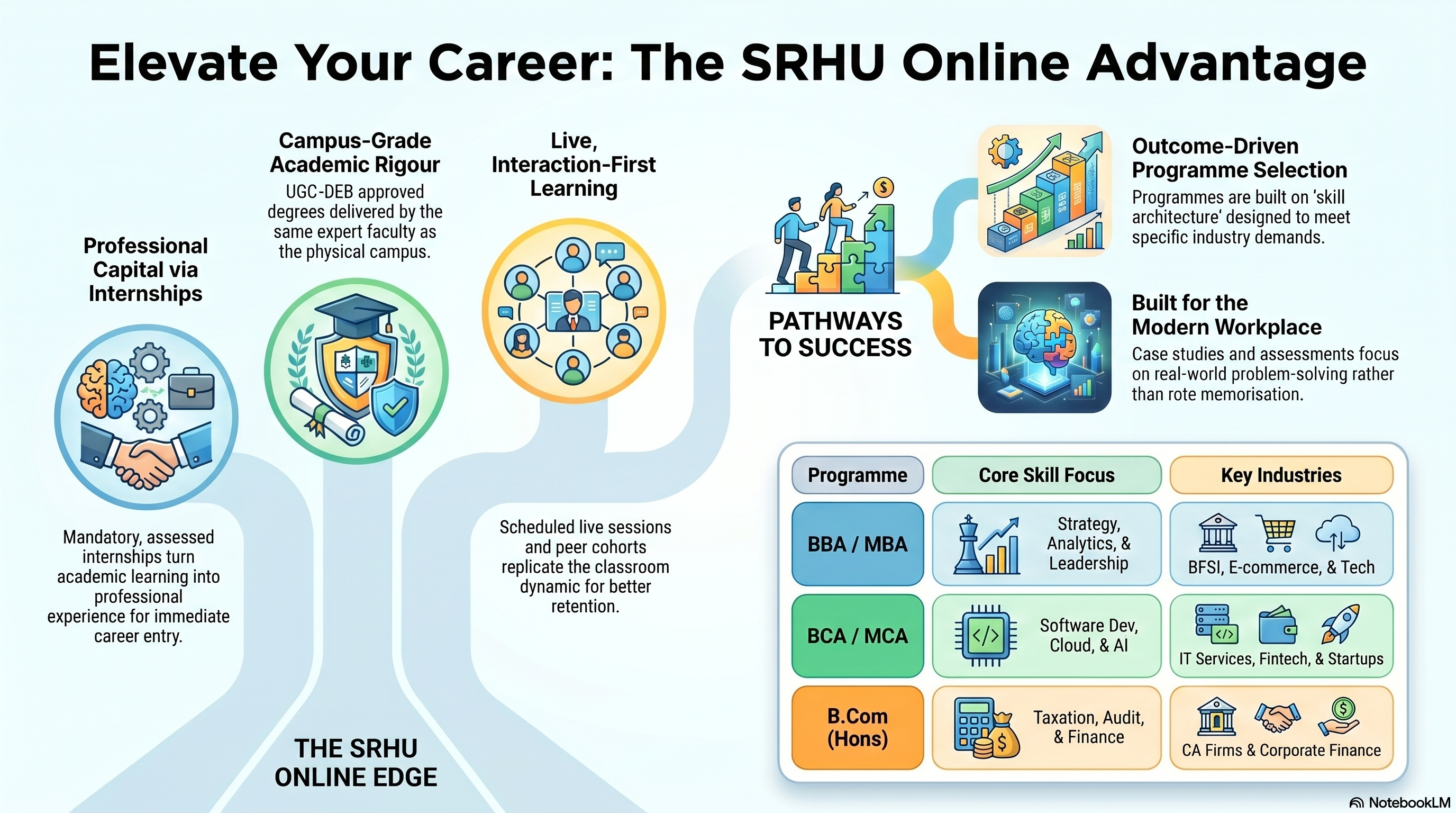
The SRHU online programs details reflect a deliberate design choice: to build programmes that carry the academic credibility of the university's established campus model while being structurally reimagined for the distributed learner. This means live sessions with faculty rather than only recorded content, cohort-based learning that replicates the peer dynamic of a classroom, and assessments that test applied capability rather than rote recall.
What makes this approach substantively different from a simple content upload is the support architecture around the learning. Online education at SRHU is built to include academic mentorship at key transition points, digital access to library and research resources, and placement support that bridges the gap between completing a programme and entering the job market a gap that is typically where online learners are most underserved.
The learning-to-career translation looks like this: structured curriculum builds domain knowledge → live sessions and peer cohorts build communication and collaboration skills → applied assessments and projects build demonstrable capability → internship and placement support builds professional entry. Each stage feeds the next. A programme that provides the first without the last three is incomplete.
What SRHU Offers Online: Programmes, Skills, and Career Paths
Understanding what courses are offered by SRHU online requires looking not just at the subject list but at the skill architecture underneath each programme because that's what employers are actually evaluating when they review a graduate's profile.
| Programme | Core Skill Areas | Target Roles | Key Industries |
|---|---|---|---|
| BBA (Hons) | Business Analytics, Digital Marketing, Finance, Management | Business Executive, Operations Analyst, Marketing Coordinator | E-commerce, BFSI, Startups, Consulting |
| MBA | Strategy, Leadership, Finance, HR, Operations | Manager, Business Analyst, Consultant, Product Lead | Pan-industry FMCG, Tech, Healthcare, Finance |
| B.Com (Hons) | Accounting, Taxation, Financial Reporting, Audit | Accountant, Tax Associate, Finance Executive | BFSI, CA firms, Corporate Finance |
| MCA | Software Dev, Data Structures, Cloud, AI basics | Software Engineer, Systems Analyst, Developer | IT, Product, Fintech, Startups |
| BCA (Hons) | Programming, Web Dev, Database, Networking | Jr. Developer, IT Support, Web Designer | IT Services, Digital Agencies, SMEs |
Across all these programmes, the SRHU online learning experience is structured to ensure that what's taught in the curriculum connects directly to what's used in the role. This means case studies drawn from current industry contexts, not historical ones; faculty who are practitioners alongside academics; and assessments designed around real-world problem-solving rather than textbook reproduction.
The Internship Dimension: Where Learning Becomes Professional Capital
One of the most significant differentiators in how SRHU approaches its online programmes is the integration of structured work experience into the academic journey. A degree with internship program isn't a feature it's a deliberate answer to the most consistent criticism of online education: that it produces credentials without experience.
In practice, this means internship requirements are built into the programme timeline, not offered as optional extras. Students are supported through placement partnerships, career mentorship, and critical academic integration, where internship learnings feed back into coursework and are assessed as part of the degree. This creates a loop between formal learning and professional application that a credential-only programme cannot replicate.
The outcome: students who complete online programmes with integrated internships enter the job market with both a recognised qualification and a professional track record. In a hiring environment that is increasingly screening for demonstrated experience at the entry level, this combination is not marginal; it's a meaningful competitive advantage.
Decision Insight
When evaluating any online programme that claims internship integration, ask one specific question: Is the internship assessed as part of the degree, or is it an optional recommendation? If it's assessed, the institution has skin in the game, faculty are reviewing the work, outcomes are tracked, and the programme quality is tied to professional performance. If it's a recommendation, it's a marketing point, not an educational commitment.
When evaluating any online programme that claims internship integration, ask one specific question: Is the internship assessed as part of the degree, or is it an optional recommendation? If it's assessed, the institution has skin in the game, faculty are reviewing the work, outcomes are tracked, and the programme quality is tied to professional performance. If it's a recommendation, it's a marketing point, not an educational commitment.
How the Online Learning Model Actually Works?
Understanding how online programs work at Swami Rama Himalayan University is best approached through the weekly experience of an enrolled student rather than a description of features.
A typical week in an online programme involves scheduled live sessions with faculty, not optional, but structured into the academic calendar, combined with self-paced study of assigned content, peer discussion forums for collaborative learning, and periodic assessments that test application rather than recall. The live sessions serve a function beyond content delivery: they build the interpersonal fluency, question-asking habit, and real-time intellectual engagement that asynchronous learning alone cannot produce.
The technology infrastructure supports but doesn't replace the pedagogical model. The learning management system organises content and tracks progress. The communication tools enable faculty-student and peer-to-peer interaction. But the quality of the experience, what students actually learn, and how well they retain it is a function of the academic design, not the platform.
The Institutional Commitment: What Makes SRHU's Approach Distinct
The question of how Swami Rama Himalayan University provides online education points to something worth examining closely: the institutional infrastructure behind the online offering.
SRHU brings to its online programmes the same faculty depth, research culture, and academic rigour that define its campus model. This is not a separate online division operating at arm's length from the main institution; it is the same university, extending its educational philosophy into a digital delivery format. That continuity matters because it means the quality assurance mechanisms, the faculty development processes, and the academic standards that apply on campus are the same ones governing online programme design and delivery.
Future Projection
Over the next three to five years, the most credible online programmes in India will be those where the parent institution's academic reputation is fully behind the digital offering, not as a brand licence, but as a genuine quality guarantee. Universities that have built integrated online programmes from their existing academic infrastructure, rather than outsourcing them to third-party platforms, will hold a significant trust advantage with employers and learners alike. SRHU's model extending campus rigour into a digital format positions it well on this dimension.
Over the next three to five years, the most credible online programmes in India will be those where the parent institution's academic reputation is fully behind the digital offering, not as a brand licence, but as a genuine quality guarantee. Universities that have built integrated online programmes from their existing academic infrastructure, rather than outsourcing them to third-party platforms, will hold a significant trust advantage with employers and learners alike. SRHU's model extending campus rigour into a digital format positions it well on this dimension.
Is Studying Online at SRHU a Good Decision? An Honest Assessment
The question of whether SRHU's online education is good for students deserves a direct answer rather than a promotional one.
For students who match the profile, self-directed, clear about career direction, unable or unwilling to relocate for campus study, and enrolled in a UGC-DEB-approved programme, the answer is yes, with evidence. The combination of an established university's academic credibility, a programme structure designed for the digital learner, and internship integration produces outcomes that are substantively comparable to campus alternatives in the private sector job market.
The caveats are real and worth naming. The quality of the experience is directly proportional to the student's own engagement. An online programme rewards active participation, consistent self-discipline, and the willingness to seek help when stuck far more than a campus environment does. Students who approach it passively will not get the same return.
| Factor | What to Look For at SRHU | Green Flag | Watch Point |
|---|---|---|---|
| Accreditation | UGC-DEB approved status | A confirmed degree is legally equivalent | Verify the specific programme, not just the university |
| Faculty quality | Practitioner + academic mix | Live sessions with current industry faculty | Purely recorded content with no live interaction |
| Internship | Assessed, not optional | Built into the academic timeline and graded | Listed in the brochure but not integrated into the degree |
| Peer learning | Cohort-based structure | Assigned cohorts + collaborative assessments | Isolated, self-paced with no peer interaction |
| Career support | Placement infrastructure + mentorship | Dedicated career cell with employer connects | Generic job board access only |
| Assessment design | Application over recall | Case-based, project-driven evaluation | Purely MCQ or rote examination pattern |
What Students Actually Gain: Beyond the Credential
The Benefits of studying through SRHU online programs go beyond the obvious ones, flexibility, cost, and accessibility to something more fundamental: the ability to build a professional identity while still being a student.
Because online learners at SRHU are often working part-time, running small ventures, or embedded in professional environments, the learning they do in the programme has an immediate application context. A module on financial management is reinforced by the financial decisions a working student is making that week. A session on operations is anchored by the supply chain problem their employer is navigating. This real-time anchoring produces a depth of retention that purely theoretical classroom learning often doesn't.
A common pattern among graduates who thrived in online programmes: they describe the experience not as studying alongside their life, but as studying through it. The learning became integrated with professional experience in a way that campus study, by its separation from the workplace, cannot easily replicate.
Making the Most of What SRHU Offers
Students who engage with Swami Rama Himalayan University online courses most effectively share a few consistent habits: they treat the live sessions as non-negotiable, they use the peer cohort as a sounding board rather than a passive network, and they approach every assessment as a portfolio piece, something that demonstrates capability to a future employer rather than a compliance task.
The students who underperform typically do so for one of three reasons: they enrolled without a clear career goal and lose motivation when the material doesn't feel immediately relevant; they skip live sessions and lose the faculty connection that gives context to self-paced content; or they treat the internship as a formality rather than the highest-value part of their degree. Understanding these patterns before enrolment rather than after is what separates a decision from a mistake.
Choosing the Right Programme: A Decision Framework
The starting point when evaluating online programs at SRHU should always be the career outcome, not the subject name. Two students enrolling in the same MBA may have entirely different reasons: one wants to move from execution to strategy, another wants to transition from engineering to product management, and a third wants to formalise twenty years of business experience for a senior leadership role. Each of those goals maps to a different set of electives, specialisations, and internship contexts.
| Career Goal | Recommended Programme | Key Specialisation/Focus | Why It Fits |
|---|---|---|---|
| Enter business/management roles from any background | BBA (Hons) or MBA | Marketing, Finance, or Operations | Broad foundation + digital business skills |
| Build an accounting and finance career | B.Com (Hons) or M.Com | Taxation, Audit, Financial Analysis | Strong for CA foundation and corporate finance |
| Move into technology roles | BCA or MCA | Software Development, Data, Cloud | Technical depth with employable output |
| Senior management/leadership transition | MBA | Strategy, HR, or Entrepreneurship | Cross-functional integration at the management level |
| Academic, civil services, or social sector | BA (Hons) | Communication, Political Science, Sociology | Conceptual depth + critical thinking foundation |
Key Takeaways
- SRHU's online programmes are not a digitised version of campus; they are a distinct learning model designed around the constraints and goals of the distributed learner.
- UGC-DEB approval is confirmed, meaning degrees carry legal equivalence with campus programmes for private sector employment and further study.
- The integration of internships into the academic structure is a genuine differentiator, not a marketing footnote, but an assessed component of the degree.
- The quality of the experience is proportional to the student's engagement. Self-direction, active participation in live sessions, and cohort involvement are the variables that separate thriving students from struggling ones.
- Programme selection should start with the career outcome, not the subject title. SRHU's range covers business, technology, commerce, and humanities, each of which maps to a specific career trajectory.
Frequently Asked Questions
1. How is SRHU adapting to digital education?
SRHU is adapting through structural redesign rather than surface digitisation. This means live, synchronous faculty sessions rather than only recorded lectures; cohort-based learning that preserves the peer dynamic of campus study; assessments designed around applied capability; and an integrated internship model that connects academic learning to professional experience. The university is also continuously updating curriculum content to reflect current industry practice, with faculty drawn from both academia and active professional roles. The adaptation is ongoing, not a one-time technology migration but a continuous realignment of academic design with learner needs and market demands.
2. How do online programs at SRHU work?
A student enrolled in an SRHU Online programme experiences a blend of live scheduled sessions, self-paced content modules, peer discussion forums, applied assessments, and structured internship integration. Live sessions, typically held on weekends or evenings to accommodate working learners, are conducted via video conferencing with faculty who facilitate discussion rather than simply deliver content. Self-paced modules allow learners to cover foundational material at their own pace. Assessments are case-based and project-driven, designed to evaluate how well students can apply concepts to realistic business or technical problems. The internship is typically timed to the mid-to-late phase of the programme, so students have sufficient academic foundation to contribute meaningfully in a professional setting.
3. What makes SRHU different in online education?
Three things distinguish SRHU's online model from the broader landscape. First, institutional continuity, the online programmes carry the same academic standards and faculty quality as the campus model, rather than being a separate, lower-resourced offering. Second, the internship integration is assessed and embedded, not optional, which addresses the experience gap that undermines most online credentials in the job market. Third, the geographic relevance: for students in Uttarakhand and the broader Himalayan region, SRHU is not just an online option among many; it is an institution with deep roots in the region, significant employment networks in local and regional industries, and faculty who understand the professional landscape graduates will be entering.
4. Why is digital education growing in universities like SRHU?
The growth in digital education at universities like SRHU is being driven by three converging forces. First, demand: India has a significant population of aspiring learners who cannot access quality higher education through conventional campus formats due to geography, cost, or professional commitments. Second, recognition: the UGC-DEB framework has created a credible accreditation path for online degrees, removing the legitimacy barrier that historically constrained the sector. Third, outcomes: as early cohorts of online graduates establish themselves in professional roles, employer attitudes are shifting. Hiring managers who were sceptical of online credentials five years ago are now interviewing and hiring graduates from accredited online programmes at universities with strong academic reputations. The evidence base is building, and SRHU's digital education expansion is both a response to this momentum and a contribution to it.